Chaos Testing
Ze includes a chaos testing mode that injects faults during operation to verify the daemon handles failures correctly. This is useful for validating configuration changes, testing plugin resilience, and finding edge cases before production.
Quick Start
# Run the native chaos unit suites.
./le chaos selftest unit
./le chaos selftest cli-unit

# Run the chaos orchestrator. le builds itself; no separate binary is needed.
./le chaos run --seed 42 --peers 4 --duration 30s
./le chaos run <options> runs the chaos orchestrator. A help word after ./le chaos run reaches the orchestrator, which
prints its own option list.
Flags
| Flag | Description | Default |
|---|---|---|
--chaos-seed <N> |
PRNG seed for reproducible faults. -1 = time-based. 0 = disabled. |
0 (off) |
--chaos-rate <f> |
Probability of fault per operation (0.0 to 1.0) | 0.1 |
Chaos Tool
The chaos tool, ./le chaos run, is a chaos simulator that runs multiple BGP peers against a ze route server, validates route propagation, and injects faults.
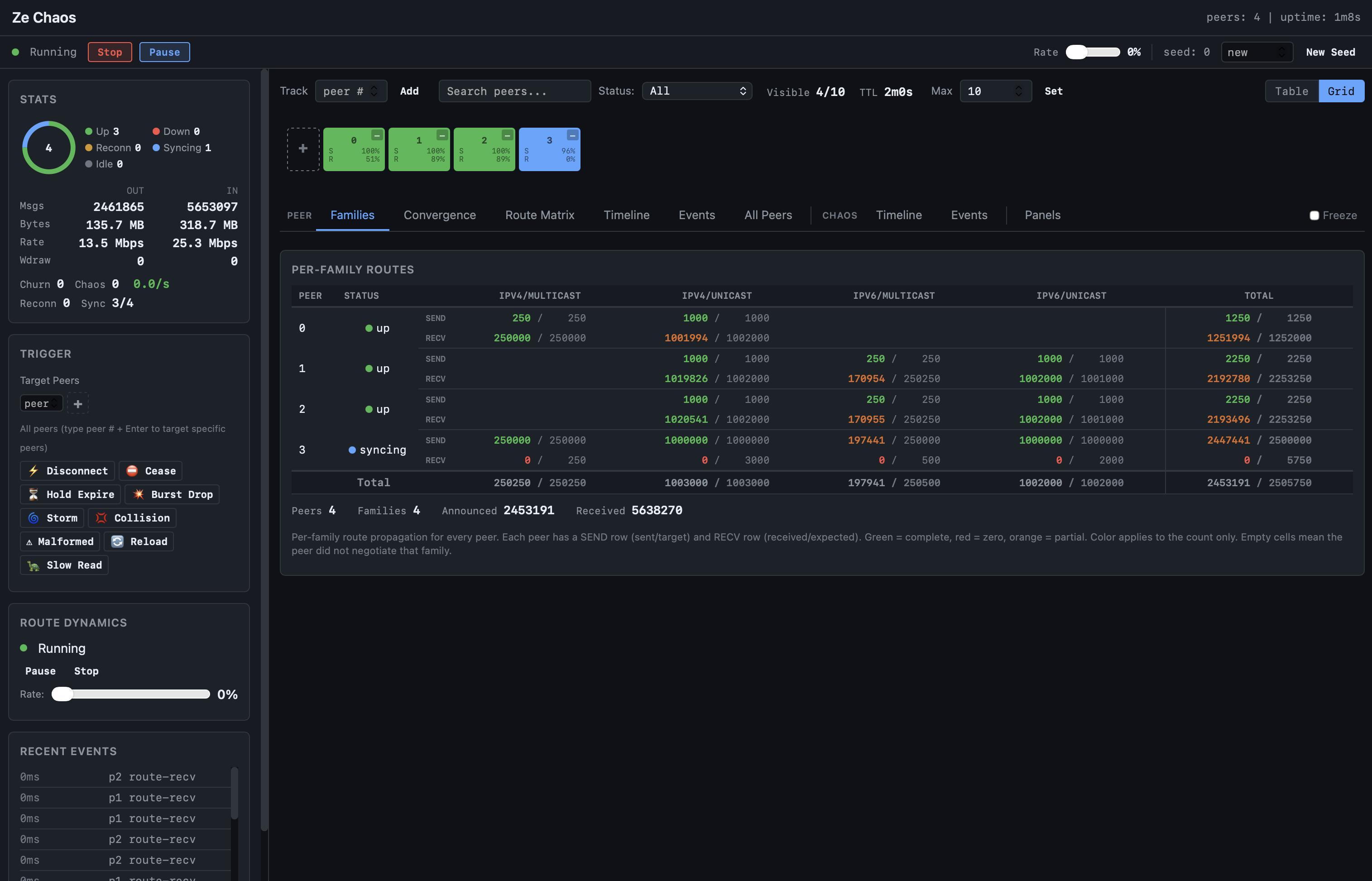
The web dashboard shows real-time peer status, per-family route propagation, convergence progress, and fault triggers. Color coding indicates propagation state: green = complete, orange = partial, red = zero.
# Fork mode (default): le chaos run starts ze as a child process
./le chaos run --seed 42 --peers 8 --duration 60s

# Specify ze binary path
./le chaos run --binary ./bin/ze --seed 42 --peers 8 --duration 60s
Fork mode runs the ze daemon that --binary names, else the ze on PATH. It
refuses when neither names a program, and it refuses a path that is the running
le itself, because le is not a ze daemon.
# Pipeline mode: config on stdout, diagnostics on stderr
./le chaos run --pipe --seed 42 --peers 8 --duration 60s | ./bin/ze -

# Write config to file
./le chaos run --config-out chaos.conf --seed 42 --peers 8
ze start chaos.conf

# In-process mode: mock network + virtual clock (fully deterministic)
./le chaos run --in-process --seed 42 --duration 30s

# In-process with chaos and route dynamics
./le chaos run --in-process --seed 42 --duration 60s --chaos-rate 0.1 --route-rate 0.05

# Multi-family
./le chaos run --families ipv4/unicast,ipv6/unicast --chaos-rate 0.2 --pipe | ./bin/ze -
Multi-Daemon Testing (FRR, BIRD)
./le chaos run can generate configs for and fork FRR (bgpd) or BIRD, so the same chaos scenario runs against different BGP implementations.
# Generate FRR config to inspect
./le chaos run --config-only --application frr --seed 42 --peers 4

# Generate BIRD config to inspect
./le chaos run --config-only --application bird --seed 42 --peers 4

# Fork FRR bgpd (auto-discovers bgpd in PATH)
./le chaos run --application frr --seed 42 --peers 4 --duration 60s

# Fork BIRD with explicit binary path
./le chaos run --application bird --binary /usr/sbin/bird --seed 42 --peers 4 --duration 60s

# Write config to file, start daemon manually
./le chaos run --config-only --application frr --config-out chaos-frr.conf
bgpd -f chaos-frr.conf -p 1850 -l 127.0.0.1 -P 0 -n -Z -S
FRR and BIRD use a single BGP port with peers identified by source IP address (127.0.0.x), unlike Ze's per-peer port model. On Linux, the 127.0.0.0/8 range is routed to loopback by default. On macOS, loopback aliases are needed:
# macOS only: create loopback aliases for each peer
for i in $(seq 2 $((peers+1))); do
  sudo ifconfig lo0 alias 127.0.0.$i
done
./le setup install adds 127.0.0.2 through 127.0.0.5 (and the IPv6 address the
functional suite binds), so the loop above is needed only for a run with more
than four peers. ./le setup check reports which addresses are missing.
Neither route survives a reboot; re-run ./le setup install after one.
Running via Docker
When FRR or BIRD is not installed locally, use Docker. The --network host
flag shares the host network so le chaos run simulators can connect directly
(Linux only; macOS Docker Desktop does not support host networking).
# Start FRR in Docker, le chaos run on the host
./le chaos run --config-only --application frr --seed 42 --peers 4 \
  --config-out chaos-frr.conf
docker run --rm --network host \
  -v ./chaos-frr.conf:/etc/frr/bgpd.conf:ro \
  quay.io/frrouting/frr:10.3.1 \
  /usr/lib/frr/bgpd -f /etc/frr/bgpd.conf -p 1850 -l 127.0.0.1 -P 0 -n -Z -S

# In another terminal: run le chaos run against the FRR instance
./le chaos run --application frr --seed 42 --peers 4 --duration 60s \
  --config-out /dev/null

# Same pattern for BIRD
./le chaos run --config-only --application bird --seed 42 --peers 4 \
  --config-out chaos-bird.conf
docker run --rm --network host \
  -v ./chaos-bird.conf:/etc/bird.conf:ro \
  --entrypoint bird bird-interop:latest \
  -f -c /etc/bird.conf -s /tmp/bird.ctl
Config Validation (no live session)
Validate generated configs without running a full session:
# FRR: -C flag checks config and exits
./le chaos run --config-only --application frr > frr.conf
docker run --rm -v ./frr.conf:/etc/frr/bgpd.conf:ro \
  quay.io/frrouting/frr:10.3.1 \
  /usr/lib/frr/bgpd -C -f /etc/frr/bgpd.conf -n -Z -S -p 0 -P 0

# BIRD: -p flag parses config and exits
./le chaos run --config-only --application bird > bird.conf
docker run --rm -v ./bird.conf:/etc/bird.conf:ro \
  --entrypoint sh bird-interop:latest \
  -c 'bird -p -c /etc/bird.conf'
Event Logging and Replay
# Record events
./le chaos run --event-log run.ndjson --seed 42 | ./bin/ze -

# Replay a recorded failure
./le chaos run --replay run.ndjson

# Shrink to minimal reproduction
./le chaos run --shrink run.ndjson
Property Validation
./le chaos run --properties all --convergence-deadline 5s | ./bin/ze -
./le chaos run --properties list    # Show available properties
Properties validated:
- Convergence: All routes reach all peers despite faults
- State consistency: RIB matches peer state after recovery
- No data loss: Updates eventually delivered
- Graceful degradation: Sessions restart on critical faults
Fault Types
| Category | Examples |
|---|---|
| Network I/O | Connection failures, partial writes, read timeouts |
| Wire parsing | Malformed messages, truncated packets |
| FSM | State machine violations, invalid transitions |
| Route processing | Dropped updates, corrupted NLRI |
| Event delivery | Lost messages, out-of-order events |
Deterministic Replay
With a fixed seed, chaos testing is fully reproducible:
# These two runs produce identical fault sequences
ze --chaos-seed 42 --chaos-rate 0.1 config.conf
ze --chaos-seed 42 --chaos-rate 0.1 config.conf
Seed 0 disables chaos entirely (zero overhead). Seed -1 uses the current time (non-reproducible).
Native Commands
| Command | Description |
|---|---|
./le chaos selftest unit |
Run chaos simulator unit tests |
./le chaos selftest cli-unit |
Run the orchestrator's command-line tests through le chaos run |
./le chaos run <options> |
Run the chaos orchestrator |
When to Use
- Before deployment: Validate your config handles peer failures
- CI pipeline: Catch race conditions and edge cases
- Debugging: Reproduce intermittent failures with a fixed seed
- Benchmarking: Measure convergence time under fault conditions