Project overview
Follow Ze from its ExaBGP roots to a network operating system: what works today, what is changing, and what remains before the first release.
Where Ze stands
Ze brings routing protocols, Linux networking and operator tools together around one configuration. It grew from ExaBGP's programmable BGP model, with a broader job: configure the network, inspect its state, and expose the same operations to people and automation.
Ze is pre-release. You can explore it in a lab today; the available capabilities and their test evidence vary by feature.
Recent work
Latest development
2026-10-25 – 2026-11-09 (16 days)
eBGP now rejects by default, routing policy is one shared tree for every protocol, RADIUS answers must be…
Read the latest updatePre-release
Before the first release
The remaining work includes correctness fixes, validation of existing behavior, and release delivery. The roadmap separates these from later features and proposals.
Work-item counts describe the backlog. They do not measure effort or production readiness.
A recorded session on a real lab router
See Ze running
Watch an ExaBGP migration, inspect BGP peers, then configure, diagnose and repair services while the same router keeps running. The recordings include the commands and their output, with transcripts you can read at your own pace.
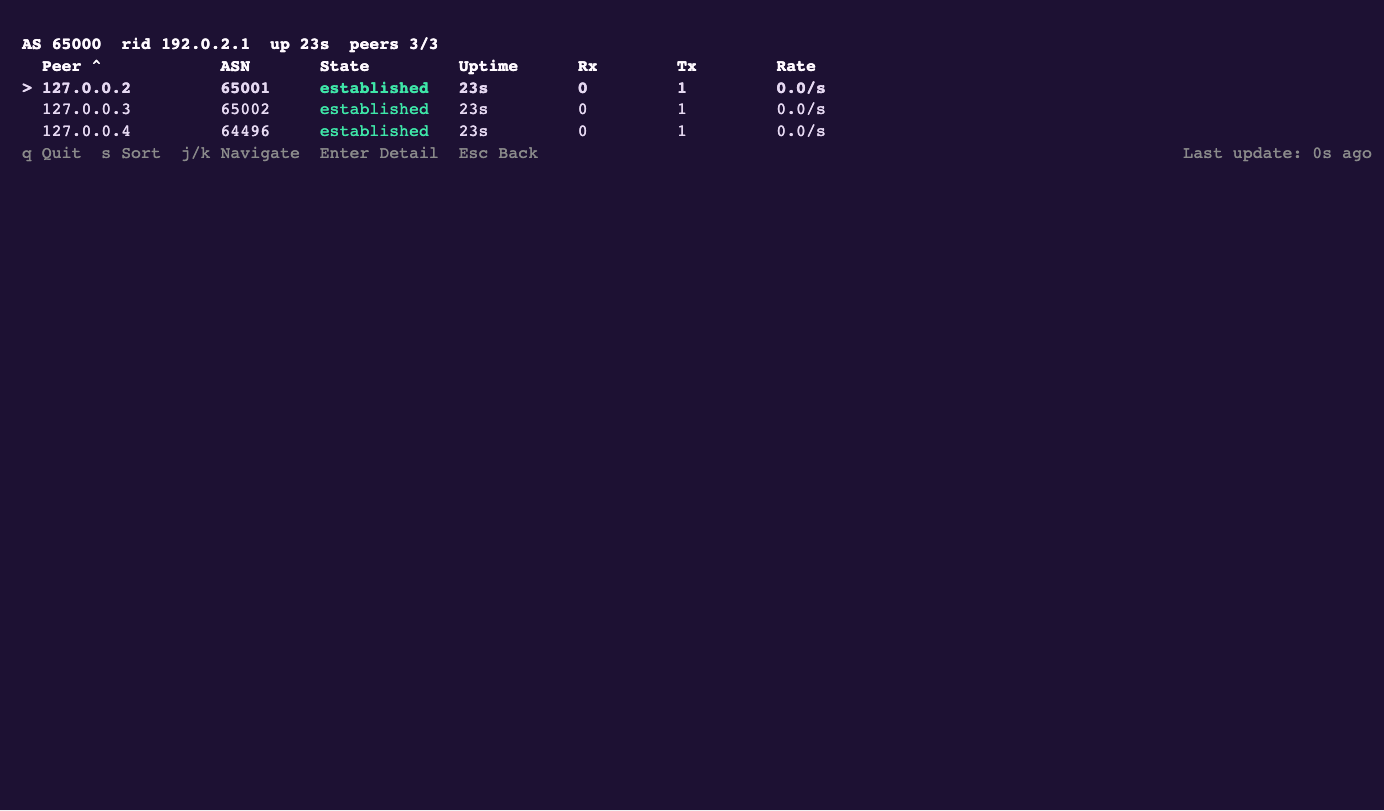 Preview from Ze's published terminal recording. Open the player to watch.
Recorded achievements
How we got here
These recent landmarks mark capabilities that arrived in Ze. The full timeline and project history explain how the system developed.
LAN caching DNS resolver
`service dns-resolver` answers DNS queries from allowed LAN and subscriber prefixes over UDP and TCP, caches answers, and forwards cache misses to configured upstream servers. DNSSEC validation is still pending.
Shared route policy
Named filters move into a shared `policy` tree, with import chains at the Loc-RIB and export chains for IS-IS and OSPF redistribution.
Ze appliance kernel
Appliance images boot Ze's own Linux kernel, with the routing and VPN support the system needs, packaged with each image.
How Ze is built
AI coding agents write most of Ze's code within a framework of specifications agreed before implementation, tests written before code, independent reviews and commit checks. That process is iterative: code and the checks that exercise it improve as problems are found. Checking a first version against every requirement takes time and resources, so published code can still be imperfect.
Most of this site's information is generated from the code. Its free text has more room for mistakes than protocol behavior defined by an RFC, so reports of unclear or incorrect information help improve it.
How Ze is developed with AIGet involved
Try Ze in a lab and report a failure with its configuration, trace or transcript. Documentation corrections, interoperability results, tests and focused code changes all help the project move forward.